Valve Treats CS2 Like an 'Adopted Child' While Deadlock Flourishes in 2026
Valve's favoritism towards Deadlock over Counter-Strike 2 echoes TenZ's adopted child comparison.
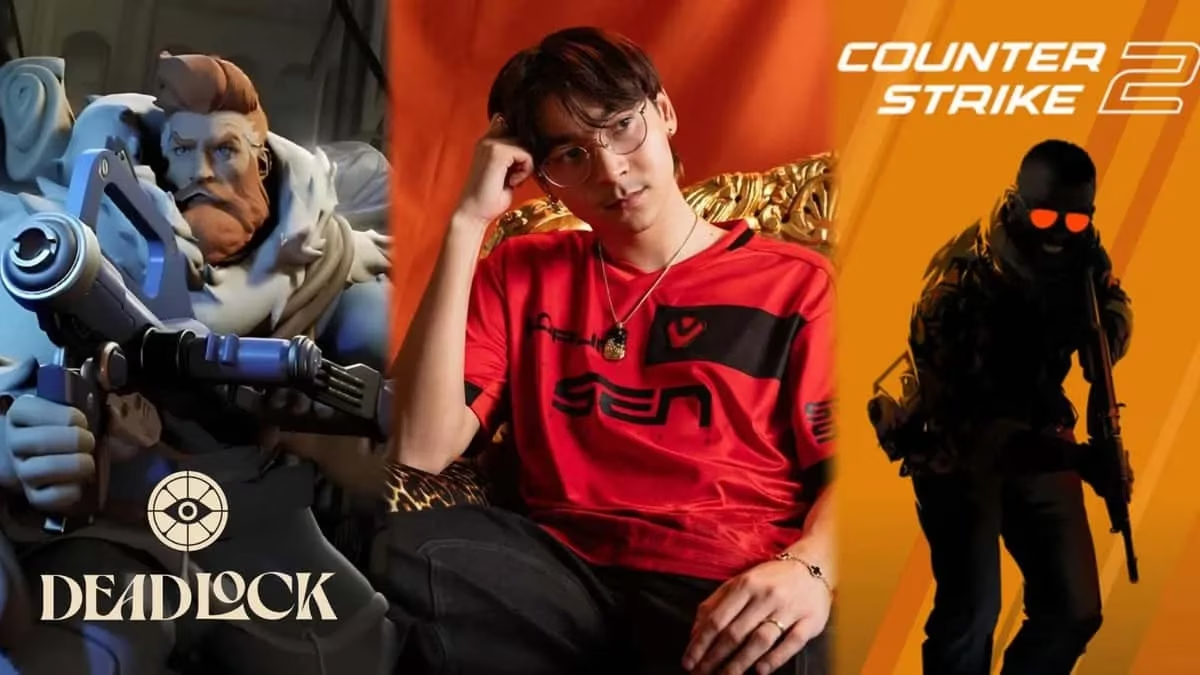
In the ever-evolving landscape of Valve's game portfolio, a stark contrast has emerged that even the most casual observer cannot ignore. As of 2026, the company’s tactical shooter Counter-Strike 2 (CS2) continues to feel like an afterthought, while the hero-shooter MOBA Deadlock receives an almost embarrassing amount of love and attention. This narrative is far from new. Back in late 2024, former CS:GO star turned Valorant icon TenZ famously compared CS2 to an "adopted child" – a sentiment that has only grown more resonant with each passing year.
The road to CS2 launched in September 2023 with sky-high expectations. Gamers worldwide anticipated a revolutionary leap thanks to the Source 2 engine. What they got instead felt more like a careful port than a transformative sequel. The initial honeymoon period was brief. Within months, the community noticed a troubling rhythm: updates were sparse, patches offered little substance, and major competitive issues lingered for weeks. By 2024, professional players were openly stating it might take another six years for CS2 to feel truly complete. One year later, in 2025, the sentiment barely shifted. Now, in 2026, the shooter still waits for meaningful content drops while its sibling thrives.
To understand the depth of the frustration, you need only glance at the update cadence of Deadlock. The game burst onto the scene unannounced in early 2024, still deep in early access, and immediately began receiving mega-sized patches at a breakneck pace. What started as a trickle of fixes became a relentless wave of new heroes, map reworks, jungle camps, items, and graphical overhauls. The development team’s communication was prompt and transparent, a stark departure from the radio silence surrounding CS2. Let’s look at a rough comparison of the two games' post-launch trajectory between late 2023 and mid-2026:
| Feature | Counter-Strike 2 | Deadlock |
|---|---|---|
| Major content updates (new maps/modes) | 2 (2024-2026) | 14+ |
| New playable characters/agents | 0 | 11 |
| Core gameplay reworks | Subtle economy tweaks | Complete ability overhauls, new objective types |
| Developer communication | Rare blog posts | Weekly patch notes, Discord Q&As |
| Esports investment | Stagnant prize pools | Rapidly growing tournament circuit |
This disparity was not lost on TenZ during a Twitch stream in late 2024 that still gets quoted in 2026. When a viewer asked why Valve even bothered switching to CS2 if they had no plans to support it, TenZ let loose. His answer was wrapped in sarcasm but carried a bitter truth: "It was mainly porting it to the Source 2 engine. But the other reason is so they can say they did it, and they’ve done some stuff, and work fully on Deadlock." He rattled off Deadlock’s achievements – two full patches bursting with content, two new heroes, fresh jungle camps, items, graphics – all while CS2’s first anniversary passed without as much as a commemorative skin. The famous analogy came moments later: "Valve already treated CS like it was its adopted child. TF2 is the cousin or something. Valve’s given the TF2 treatment to CS2."
That TF2 comparison stings because Team Fortress 2 has long been the poster child for Valve’s neglect. To hear a former CS:GO pro say the same fate has befallen Counter-Strike in 2026 feels like a punch to the gut for millions of players. The "adopted child" metaphor captures a family dynamic where the biological kid gets all the toys. Deadlock is the favorite offspring, showered with gifts, overnight hotfixes, and community listening sessions. CS2 is handed a couple of quarterly bug fixes and told to be grateful.
Why this divide? TenZ pointed a finger at the top, specifically at Valve President Gabe Newell. His theory, shared on stream and later echoed by many in the community, is simple: GabeN prefers MOBAs over shooters. Over the years, Gabe has been spotted at countless Dota 2 Internationals, sitting in the crowd, mingling with fans. He has never appeared at a single CS Major. This personal investment, or lack thereof, trickles down. Deadlock, with its MOBA-DNA and hero-based combat, naturally attracts the same kind of strategic depth that Gabe loves. CS2, for all its precision gunplay, cannot compete for that parental affection.
Fast forward to 2026 and the evidence is everywhere. Deadlock has officially left early access and now boasts a robust esports scene, three new hero releases per year, a sprawling narrative, and a content pipeline that makes other live-service games blush. CS2, meanwhile, clings to its hardcore player base through sheer inertia and the occasional operation that recycles old favorites. The community’s mood swings between gallows humor and genuine outrage. A popular meme among the player base depicts CS2 as a spartan dog sitting in a burning room saying "This is fine," while Deadlock stands outside dancing in a rain of golden updates.
It’s not all doom and gloom. CS2’s core mechanics remain rock-solid; the gunplay is crisp, the movement familiar. But in the modern era where live-service games thrive on constant evolution, stability doesn’t cut it anymore. Players want a reason to come back every week, not just the same inferno they’ve walked a thousand times before. They see Deadlock’s map transforming with each season, new verticalities, new neutral objectives, and they wonder: why can’t we have that?
TenZ’s words from two years ago have become prophecy. The “adopted child” lives in the basement while the golden boy throws parties upstairs. Unless Valve undergoes a dramatic shift in priorities, 2026 will be remembered as the year the MOBA love-in choked out Counter-Strike’s future. One can almost hear the sarcastic birthday card that never arrived: “Happy birthday Counter-Strike! You got nothing – again.”