The Quiet Death of DMZ: How Warzone's Extraction Mode Was Left Behind
Call of Duty: Warzone 2 DMZ mode, abandoned by Activision, now fuels nostalgia by 2026.
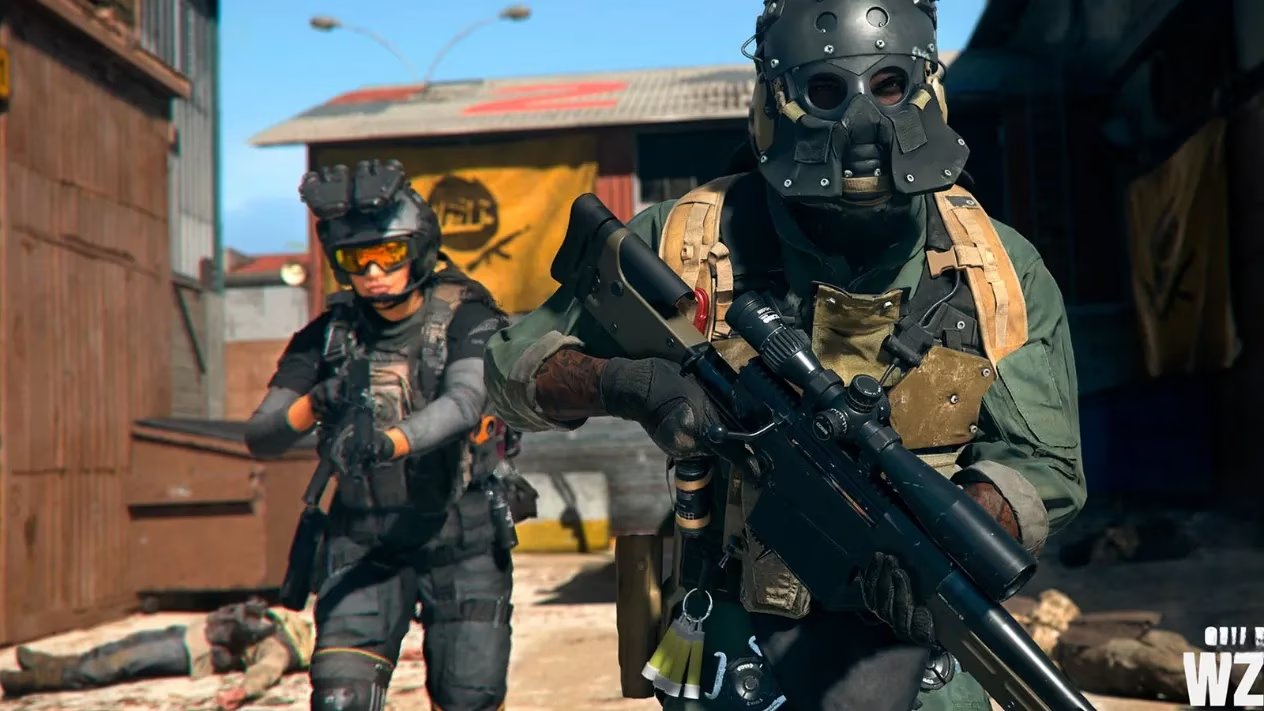
Back in 2023, the Call of Duty landscape was buzzing with anticipation. Modern Warfare 3 was on the horizon, and the annual Call of Duty Next event had just wrapped up, showering fans with details on campaign missions, reimagined multiplayer maps, open-world Zombies, and the evolving Warzone ecosystem. Yet amid all the noise, one mode sat in total silence. DMZ—the extraction shooter experiment introduced with Warzone 2—received no roadmap, no feature update, and not even a passing mention. In a room full of loud announcements, that silence spoke volumes.
Players who had poured hours into DMZ back then remember its refreshing take on the battle royale formula. Instead of a shrinking circle forcing everyone into a final firefight, DMZ dropped squads into sprawling maps like Al Mazrah, Ashika Island, and Vondel, leaving them to decide their own objectives. You could hunt for rare contraband, tackle faction missions, or just sneak through enemy territory to extract with a backpack full of loot. The mode borrowed heavily from games like Escape From Tarkov, but simplified it enough for console shooters to feel right at home. It was tense, rewarding, and, for a while, genuinely addictive.

What made the CoD Next presentation so alarming to its community wasn’t just the absence of planned content—it was the confirmation that no updates were coming at all. DMZ would remain chained to Modern Warfare II, while progression, weapons, and operator skins moved forward with MW3 and the new Warzone map, Urzikstan. At a time when even the Zombies mode was adopting an extraction loop (letting players stash weapons and perks for later deployments), the writing on the wall became impossible to ignore. The core appeal of DMZ had been politely stolen and repackaged elsewhere.
By the time Modern Warfare 3 launched in November 2023, the fate of DMZ was already sealed. A few loyal players stuck around, hoping for a miracle patch or a seasonal refresh, but the lobbies grew emptier with each passing week. The mode’s fixed map pool started to feel like a museum exhibit—frozen in time while the rest of the game sprinted forward. No new objectives, no balance adjustments, not even a seasonal pass integration. It was a live service mode in technical name only.
Fast forward to 2026, and any mention of DMZ triggers a wave of nostalgia among long-time Call of Duty fans. The mode hasn’t been officially shut down, but finding a full squad without waiting ten minutes is a challenge in most regions. Activision never issued a eulogy; they simply let it fade. This passive retirement approach is something the franchise has perfected over the years—shifting resources quietly until the player base dwindles enough to justify pulling the plug entirely. And with annual releases demanding more attention than ever, a mid-experiment mode like DMZ never stood a chance.
Looking back, DMZ’s quiet death offers a lesson about the cost of splitting a community across too many experiences. It had ambition, a dedicated player base, and genuine potential to evolve alongside Warzone’s main mode. But in a world where Call of Duty is simultaneously a traditional multiplayer shooter, a battle royale, a co-op survival game, and a narrative campaign, something had to give. The Zombies mode’s extraction twist—rolled out in MW3 and expanded in later titles—proved easier to market and faster to develop, leaving the original blueprint in the dust.
Will DMZ ever return? In 2026, rumors occasionally surface about a standalone extraction game from the Call of Duty universe, but nothing concrete has materialized. For now, the only remnants are buried in old Reddit threads and the memories of those late-night deals turned south by an ambush at the exfil chopper. The game mode didn’t explode in a dramatic server shutdown. It simply stopped being part of the conversation—and sometimes, that’s the quietest way for a live service to die.
As detailed in reporting from Polygon, live-service modes often live or die by whether publishers keep them inside the main content stream; DMZ’s “quiet fade” fits that pattern, since cutting it off from MW3-era progression and seasonal beats effectively signaled to players that the extraction experiment was no longer a priority even before matchmaking thinned out.