The Great Steam Refund Loophole: How Call of Duty HQ Complicates Modern Warfare 3 Returns
Call of Duty: Modern Warfare 3 refund issues on Steam highlight a frustrating loophole in the COD HQ launcher, leaving gamers dissatisfied and seeking solutions.
In the ever-evolving landscape of digital gaming, where a few clicks can grant access to sprawling virtual worlds, the promise of a hassle-free refund stands as a digital consumer's last line of defense. Yet, for legions of soldiers who enlisted in Call of Duty: Modern Warfare 3's rocky 2026 deployment, that line has been fortified by an unexpected and rather inconvenient feature. The latest entry in the rebooted series, not to be confused with its 2011 namesake, launched with a campaign that critics called lackluster, a battalion of bugs, and technical issues severe enough to prevent some PC players from even booting up the game. This led to a wave of refund requests, a perfectly reasonable reaction to a product not meeting expectations. However, many found their retreat blocked not by enemy fire, but by a quirk in Steam's automated refund system, masterfully exploited by the game's own architecture. It turns out, getting your money back for MW3 is a mission more complex than any Spec-Ops objective.

At the heart of this digital debacle is the Call of Duty HQ launcher. Think of it not as a simple game icon on your desktop, but as a sprawling military base that houses multiple operations. Though Modern Warfare 3 is listed and sold as a full, standalone title on Steam, it doesn't run independently. Instead, it boots up from within this unified COD HQ, the same launcher that also hosts Modern Warfare 2 (2022) and the free-to-play Warzone. This shared living arrangement creates a critical accounting error in the eyes of Steam's famously player-friendly refund policy. The platform's automated system promises a no-questions-asked refund for any game with less than two hours of playtime. A simple, elegant rule. But here's the rub: Steam tracks 'playtime' for the Call of Duty HQ application as a whole, not for the individual game inside it. So, if a player has sunk 50 hours into Warzone and 30 hours into MW2 over the past year, their 'playtime' for the HQ shows as 80 hours. The moment they launch MW3 for the first time, Steam sees a player with 80+ hours in the 'game,' instantly voiding the automatic refund option. It's a classic case of guilt by association, where time spent liberating Verdansk is counted against you when you want to abandon the underwhelming missions of MW3.
The implications are as clear as they are frustrating:
-
The Automated Door Slams Shut: For anyone with a history in the COD HQ ecosystem, the standard, instant Steam refund path is immediately unavailable.
-
A Perceived Loophole: While likely an oversight in design rather than a malicious scheme, the effect is a feature that functionally discourages refunds for a game that has faced significant criticism.
-
Community Backlash: This technicality has fueled player frustration, adding 'refund difficulty' to the list of launch woes alongside bugs and campaign complaints.
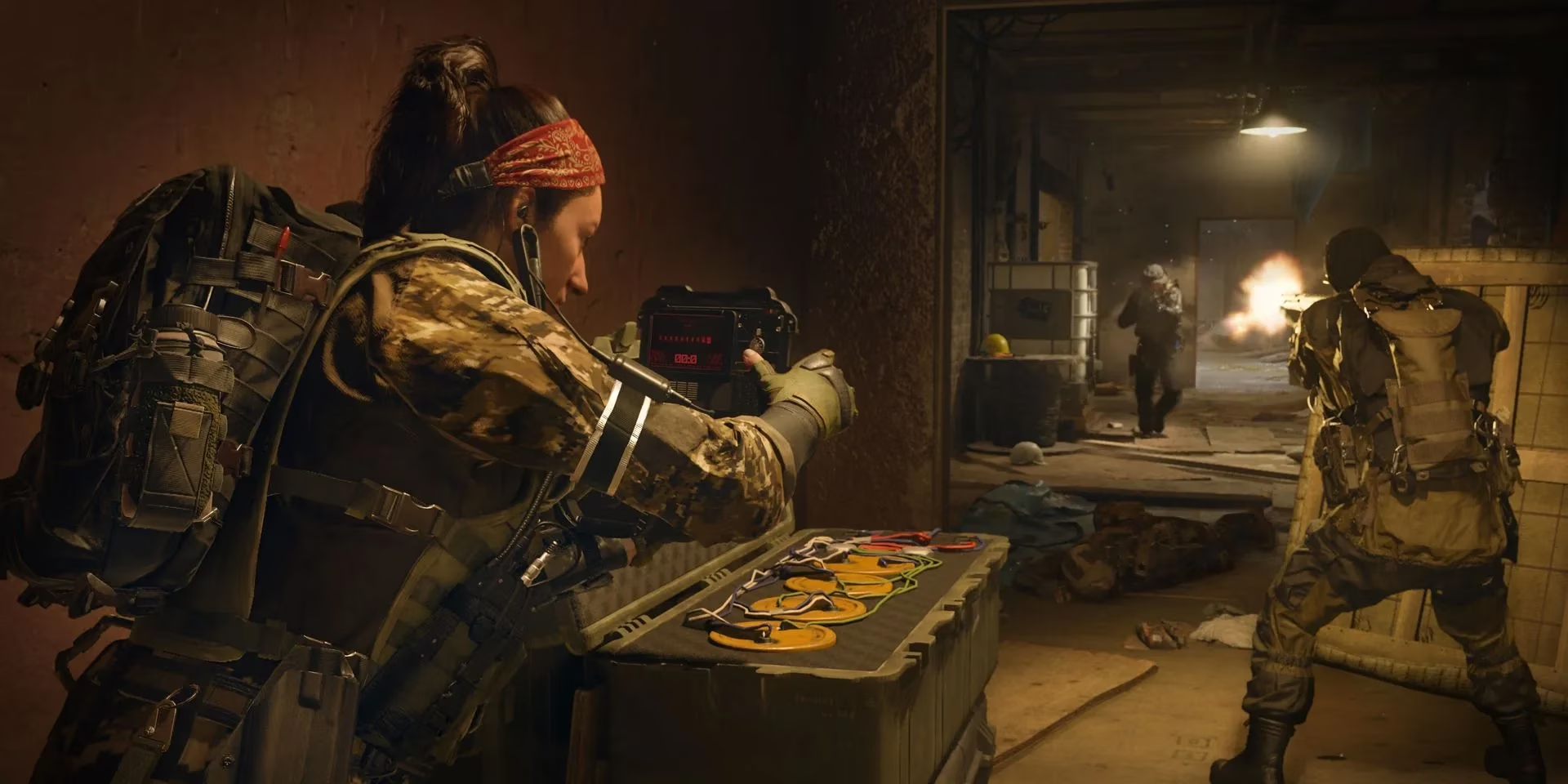
So, is the mission a complete failure? Are players simply out of luck? Not quite. There is a workaround, a way to flank this automated defense. The key is to go manual. Instead of relying on the automated request system, players must directly contact Steam Support. This involves explaining the situation—that the playtime listed is for the COD HQ launcher and previous titles, not for Modern Warfare 3 itself. While this method is more cumbersome and not guaranteed (as it relies on the discretion of a support agent), it has proven successful for many. It's the digital equivalent of asking to 'speak to the manager,' but in this case, the manager might actually understand the convoluted mess of modern game launchers.
Looking at the broader picture, the ideal, long-term solution seems obvious. The Call of Duty franchise, a behemoth in the industry, could easily implement separate, distinct launchers for its major annual releases. This would cleanly segment playtime for Steam's tracking purposes. Alternatively, Activision could work with Valve to implement a more nuanced playtime tracking system within shared launcher frameworks. Until such changes are made, the situation remains a quirky case study in how modern game distribution and legacy platform policies can clash. For now, players eyeing the next Call of Duty release in late 2026 would be wise to remember this episode. The promise of a seamless, unified game hub comes with fine print, and sometimes, that fine print can cost you your refund. 🎮⚠️